..
|
Follow this link for some older introduction pages:
http://www.bigel-labs.de/3.Physik/3.HEPlasmen.htm
Abstract:
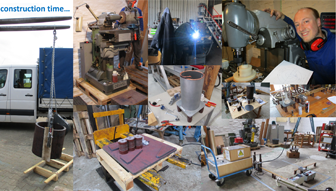
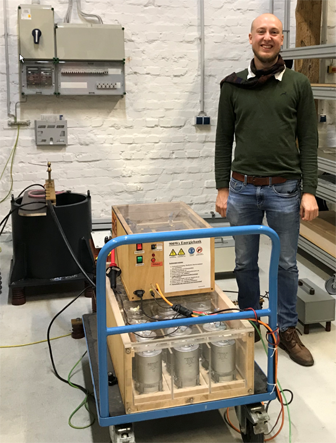
This page presents my Master's thesis, completed in 2019 at the University of Rostock, under the Chair of High Voltage and High Current Engineering, supervised by Prof. Dr.-Ing. Dirk Uhrlandt All mechanical assemblies for the project were independently designed in CAD and later realized in practice.
The objective of this project is the analysis of pulsed capacitor discharges through steel wires with varying geometries. Discharges at high energy density levels produce pressure waves which have numerous application possibilities in industry. Experimental trials are performed using a series RLC configuration (C = 150 μF, U = 6 kV), with the wire producing the circuit damping. In an effort to predict the optimum wire and circuit dimensioning for maximum energy transfer efficiency, various experiments are performed. Wire lengths ranging from 20 mm – 160 mm and wire diameters from 0,6 mm – 0,8 mm are used.
The pulse current and voltage across the wire is measured for each separate wire configuration. This allows the computation of the absorbed energy within each individual wire resp. wire‐plasma as well as the power. An analysis of the electrical resistance behavior of these wire‐plasmas are performed to find the time independent Specific Resistance Characteristic for various wires.
A time independent fit function is used to relate the specific resistance to the wire energy density. It was possible to discover a coupled system of ordinary differential equations (ODEs), using a semi‐physical model, which in turn allows the computation of the pulse current during discharges. The known circuit parameters as well as the time independent resistance is used to numerically solve the differential equation system through the implementation of an adaptive Runge‐Kutta method.
This new model may help to plan, design and construct experimental and industrial pulsed wire discharge systems. By using these methods, one is capable of predicting the current, the wire voltage, the capacitor voltage, as well as the energy distribution and efficiency for pulsed steel wire discharge systems using known circuit parameters.
Based on the results of the Master's thesis, a paper was published in the Journal of Applied Physics in collaboration with Prof. Dirk Uhrlandt and Petrus Pieterse: Energy dissipation and efficiency of exploding stainless steel wires of various lengths and diameters
|
|
Max
Bigelmayr, Upload Dezember 2025
|